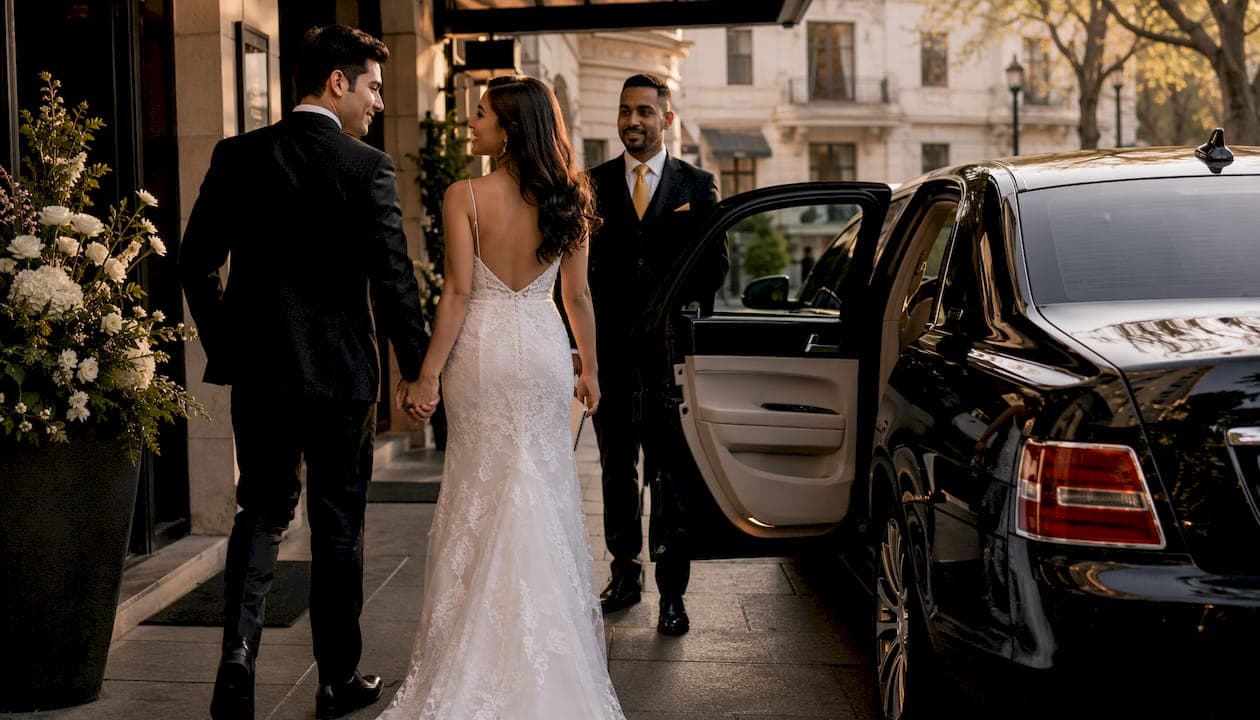
Most U.S. couples spend about $1,075 on wedding transportation, according to The Knot Real Weddings Study. In practice, the planning range runs $800–$1,500 for a typical setup, though bridal-car-only arrangements can come in at $300–$600 and full multi-vehicle packages regularly exceed $3,000. That spread is wide because wedding transportation cost depends heavily on three things: where you live, how many vehicles you need, and how many hours you reserve them.
Regional averages tell part of the story. Couples in the Northeast and New England often pay significantly more than in the Southwest for comparable service. Guest count and vehicle mix do the rest of the work. A couple hiring one sedan for the ceremony runs a very different bill than one coordinating a bridal car, a party bus for the wedding party, and two shuttle loops for out-of-town guests.

For couples in Georgetown, SC and the surrounding area, Shermaine's Limo & Executive Logistics offers full-service wedding logistics, from a single bridal car to multi-vehicle coordination, with a secure online booking process and experienced chauffeurs who handle the day-of details so you don't have to.
Table of Contents
- What does the average wedding transportation cost look like by package size?
- How much does each vehicle type cost per hour?
- What do quotes usually include, and what fees catch couples off guard?
- What actually drives your wedding transportation price up or down?
- How can you cut wedding transportation costs without losing coverage?
- When should you book, and what deposit should you expect?
- What are the tipping rules and who pays for what?
- What questions should you ask every transportation vendor before booking?
- Why Shermaine's Limo & Executive Logistics is worth considering for your wedding
- Key Takeaways
- The mistake most couples don't realize they're making
- Ready to get a written quote for your wedding transportation?
- Sources and further reading
What does the average wedding transportation cost look like by package size?
The national average reflects a mid-range setup, but what that actually buys varies by wedding size. The three scenarios below show how costs stack up with clear assumptions so you can adapt them to your own headcount, without specifying exact dollar amounts.

| Package | Vehicles Included | Hours Booked | Estimated Total | Key Assumptions |
|---|---|---|---|---|
| Intimate (under 50 guests) | 1 luxury sedan or stretch limo | A few hours | Moderate cost | Bridal car only; no guest shuttle; minimum hours apply |
| Standard (50+ guests) | 1 bridal car + 1 shuttle loop | Several hours per vehicle | Higher cost | Guest shuttle covers hotel-to-venue; gratuity not included |
| Large | 1 bridal car + 2–3 shuttles or party bus | Several hours per vehicle | Significantly higher cost | Multiple pickup points; positioning time per vehicle adds cost |
A few assumptions worth flagging: most providers charge a 3–5 hour minimum, so even a short transfer gets billed at the minimum rate. Gratuity (typically 15–20%) is often not included in the base quote. And each additional vehicle carries its own minimum and often a positioning hour at the start and end of service, which is how a "simple" two-vehicle setup can quietly climb past $2,000.
Pro Tip: When comparing quotes, ask whether the estimate includes positioning time and gratuity. Two quotes that look identical on paper can differ by $300 or more once those line items appear.
How much does each vehicle type cost per hour?
Vehicle choice is the most visible lever on your bill. Hourly rates and capacities vary widely among vehicle types typically used for weddings. Larger vehicles and luxury options cost more per hour and are booked for multiple hours depending on their role—such as bridal car, guest shuttle, or wedding party transport—but exact prices vary by provider and location.
Hourly rate data sourced from LimousineHQ's 2026 pricing study.
A few practical notes: party buses and motorcoaches almost always carry 3–5 hour minimums, so the "estimated total" column reflects real-world booking patterns, not just the math of one hour times the rate. Vintage cars are often booked for shorter windows because they're primarily used for photos and the ceremony transfer, not extended loops. For guest shuttles, a minibus or motorcoach sized correctly for your headcount will almost always cost less per person than running multiple smaller vehicles.
What do quotes usually include, and what fees catch couples off guard?
Most base quotes cover the vehicle, a licensed chauffeur, and the agreed booking hours. Everything else is negotiable, and some of it shows up only after you've signed.
Typically included in a standard quote:
- The vehicle for the reserved time block
- A licensed, insured chauffeur
- Fuel for the agreed route
- Basic amenities (water, ice, sometimes champagne flutes)
Common extras that inflate the final bill:
- Positioning/deadhead miles: The charge for the driver traveling to your pickup location before the clock starts. Some operators include this; many don't.
- Overtime: Most contracts specify a per-15-minute or per-30-minute rate if you run long. At $50–$75 per 30 minutes on a party bus, a 45-minute ceremony delay adds up fast.
- Tolls and parking: Usually passed through at cost. Ask upfront if your route involves toll roads or venue parking fees.
- Cleaning fees: Standard for standard messes; higher (sometimes $150–$300) if the vehicle requires deep cleaning.
- Gratuity: 15–20% of the fare is customary. Some contracts include it; many do not.
- Fuel surcharges: More common since 2022 and still appearing in contracts in 2026.
On insurance: reputable providers carry commercial auto liability coverage, and most require a certificate of insurance. Some venues require vendors to be named on the venue's policy as an additional insured. Confirm this before signing anything, because a gap in coverage can create liability for the couple if an incident occurs on venue property.
What actually drives your wedding transportation price up or down?
The single most important thing to understand about transportation pricing is that you're buying time, not miles. Operators price by hours reserved, not by distance traveled. A 10-minute ceremony transfer still costs several hundred dollars because the driver and vehicle are reserved for a minimum block, whether or not they're moving.
Hours reserved. This is the dominant variable. A 3-hour minimum at $150/hr costs $450 before gratuity. Extend to 5 hours and you're at $750. Add a second vehicle and you've doubled the minimums.
Vehicle type and count. As noted above, adding vehicles is the fastest way to grow the total. Each one brings its own minimum, its own positioning charge, and its own gratuity line.
Date, day, and season. Saturday weddings in May, June, September, and October carry peak-season surcharges at most providers. Friday and Sunday weddings often come in 10–20% lower. Holiday weekends can push rates even higher.
Logistics complexity. Multiple pickup locations, a long gap between ceremony and reception, and late-night returns all extend the time block. A venue 30 miles from the hotel is not inherently more expensive than one 5 miles away. What costs money is the extra hours the driver sits waiting between runs.
Regional market. Northeast and New England averages run nearly double the Southwest for similar service, driven by labor costs, fleet availability, and demand concentration in dense metro areas.
Pro Tip: Schedule all your transfers within a single continuous booking block rather than fragmented windows with long gaps. A vehicle sitting idle for two hours between the ceremony and reception still runs on the clock.
How can you cut wedding transportation costs without losing coverage?
Smart couples don't cut vehicles. They cut wasted time and redundant trips.
Consolidation is the highest-leverage move. Instead of booking a separate vehicle for every subgroup, design your logistics so one vehicle makes multiple trips or one larger vehicle replaces two smaller ones. A 20-passenger minibus making two loops costs less than two 10-passenger sprinters running simultaneously.
Right-size your vehicles. WeddingWire's guidance is direct on this: an under-used luxury showpiece inflates the budget without improving logistics. A party bus booked for 15 people when a sprinter would do the job wastes money on capacity you're not using.
Other practical tactics:
- Book a hotel block close to the venue. Shorter distances mean fewer shuttle loops and less wait time billed to you.
- Limit the bridal car to ceremony and portrait time only. Releasing it after portraits rather than keeping it through the reception can save 2–3 hours of charges.
- Ask about package pricing. Many providers offer bundled hour blocks at a lower effective rate than booking by the hour.
- Choose a Friday or Sunday wedding date if your venue allows it. Off-peak day discounts are real and often negotiable.
- Confirm whether gratuity and taxes are already in the quote before comparing two bids. A quote that looks $200 cheaper may not be once you add 20% gratuity.
When should you book, and what deposit should you expect?
-
Book 6–12 months out in competitive markets. Quality vehicles and experienced chauffeurs sell out well ahead of peak-season Saturdays. In major metro areas, popular party buses and vintage cars can be gone a year in advance. Georgetown and smaller markets have more flexibility, but 6 months is still a safe minimum.
-
Expect to pay a deposit at booking, typically a significant portion of the total cost. Most providers require a non-refundable deposit to hold the date. The balance is typically due 2–4 weeks before the wedding. Confirm whether the deposit is refundable under any circumstances before signing.
-
Get everything in writing. The contract should specify vehicle type, pickup times, pickup locations, number of hours, overtime rate, and whether gratuity is included. A verbal confirmation is not a contract.
-
Confirm 48–72 hours before the wedding. Call or email the provider to confirm the itinerary, driver's name and cell number, and the exact pickup sequence. This one step prevents most day-of surprises.
-
Create a driver call sheet. Give every driver a printed or digital sheet with the full schedule: names, addresses, times, and a contact number for the wedding coordinator. Drivers who know the plan don't need to call you on the morning of your ceremony.
-
Understand the cancellation policy. Some contracts allow rescheduling with notice; most do not refund deposits. If you're booking more than a year out, ask whether the provider offers a credit toward a future date if plans change.
What are the tipping rules and who pays for what?
Standard gratuity is commonly expected, often calculated as a percentage of the total fare or a customary amount per driver for short transfers. Many contracts include it automatically; many don't. Check the contract line by line before assuming it's covered.
Who typically pays:
- The bridal car is almost always paid by the couple or the couple's family.
- Wedding party transport (party bus, sprinter) is usually covered by the couple, though some wedding parties split the cost among members.
- Guest shuttles are paid by the couple in most cases. Some families split the cost when the shuttle primarily serves one side's out-of-town guests.
Etiquette notes couples often miss:
- Tell guests clearly whether return trips are provided and until what time. A shuttle that stops running at 10 PM while the reception goes until midnight creates real problems.
- If guests are expected to arrange their own rides home, say so explicitly on the wedding website or in the program. Rideshare codes or a list of local cab companies are a thoughtful addition.
- If gratuity is not in the contract, prepare envelopes for each driver and designate someone (a coordinator, a family member) to distribute them at the end of service. Drivers should not have to ask.
What questions should you ask every transportation vendor before booking?
- What is your hourly minimum, and does it include positioning time?
- What is your overtime rate, and how is it billed (per 15 minutes, per 30 minutes, per hour)?
- How old is the vehicle we'd be assigned, and when was it last inspected?
- How many drivers will be on-site, and do you carry backup vehicles for mechanical failures?
- What commercial liability coverage do you carry, and can you provide a certificate of insurance?
- Can you accommodate multiple pickup locations, and how do you handle unexpected delays (ceremony running late, traffic)?
- Is gratuity included in the quote, or is it expected separately?
- What is your cancellation and refund policy, and under what conditions can we reschedule?
- Does the quote include fuel, tolls, and parking, or are those passed through at cost?
- Will you provide a written itinerary with driver names, cell numbers, and pickup times before the wedding day?
That last question is the most telling. Providers who build detailed call sheets as a standard practice are the ones who've done this enough times to know what goes wrong.
Why Shermaine's Limo & Executive Logistics is worth considering for your wedding
Shermaine's Limo & Executive Logistics, based in Georgetown, SC, handles the full range of wedding transportation needs, from a single bridal car to multi-vehicle coordination covering the wedding party and guest shuttles. The service is built around chauffeur-driven luxury vehicles with a focus on reliability and day-of logistics management.
What sets Shermaine's apart for wedding clients:
- Locally managed fleet: Vehicles and drivers are managed directly, not brokered through a third-party network, which means better accountability on the day.
- Secure online booking and payment: The booking process is handled through a secure platform, with clear written confirmation of vehicle, times, and pricing.
- Experienced chauffeurs: Drivers are trained for event logistics, not just point-to-point transfers, which matters when ceremony timing shifts or a pickup location changes.
- Personalized itinerary planning: Shermaine's works with couples to build a written call sheet covering every pickup, drop-off, and timing window before the wedding day.
- Backup planning: Having a local provider who can respond to day-of changes is a real advantage over booking through a national aggregator with no local presence.
For couples who want to avoid the most common booking pitfalls, including surprise fees, under-sized vehicles, and drivers who don't know the venue, a locally managed provider with a clear contract and written itinerary is the lower-risk choice. Request a written quote that itemizes hours, positioning fees, and gratuity so you can compare it accurately against any other bids.
Key Takeaways
The national average wedding transportation cost is $1,075, but your real number depends on vehicle count, hours reserved, and your region.
| Point | Details |
|---|---|
| National average spend | The Knot Real Weddings Study puts the U.S. average at $1,075, with a typical planning range of $800–$1,500. |
| Package totals by size | Intimate setups run $300–$600; standard packages $800–$1,500; large multi-vehicle plans $3,000–$4,000+. |
| Biggest cost driver | Adding vehicles raises the total fastest; each carries its own 3–5 hour minimum and positioning charges. |
| Top cost-saving move | Consolidate pickups into one continuous booking block and right-size vehicles to your actual guest count. |
| Shermaine's Limo & Executive Logistics | Georgetown, SC couples can book a locally managed bridal car, wedding party vehicle, or guest shuttle with written itinerary and secure online payment. |
The mistake most couples don't realize they're making
Most wedding transportation budgets go wrong before a single vehicle is booked. The problem isn't the hourly rate. It's the assumption that you're paying for a trip.
You're not. You're paying for a reserved time block, and that distinction changes every decision that follows. A couple who books three separate vehicles for three separate windows, each with its own 3-hour minimum, can easily spend $1,500 more than a couple who designs the same coverage into two vehicles running continuous blocks. The math is identical in terms of coverage. The cost is not.
The second mistake is treating gratuity as optional. It isn't, really. A driver who manages your ceremony timing, waits through a 45-minute photo overrun, and navigates a venue with no clear signage has earned 20%. Budget it from the start so it doesn't feel like a surprise at the end of the night.
The third mistake is booking too late and then accepting whatever's available. A vehicle that's still open three weeks before a peak-season Saturday is available for a reason. Book early, get the contract in writing, and confirm the itinerary 48 hours out. Those three steps eliminate most of the risk.
Ready to get a written quote for your wedding transportation?
Shermaine's Limo & Executive Logistics takes the guesswork out of wedding day logistics. Whether you need a single luxury bridal car or a full coordination plan covering the wedding party and guest shuttles, the team builds a written itinerary for every booking so there are no surprises on the day.

Georgetown, SC couples and those planning events in the surrounding area can view available services and request a written quote that itemizes vehicle type, hours, positioning fees, and gratuity. Deposits typically run 25–50% at booking, with the balance due before the wedding date. Secure online payment is available from the first confirmation.
Book your wedding transportation today and get a written itinerary with your quote.
Sources and further reading
The figures in this article come from the following industry sources. Time-sensitive pricing data reflects 2026 U.S. national averages where noted.
- The Knot Real Weddings Study — Source of the $1,075 national average and regional breakdowns (Southwest ~$755, Northeast/New England ~$1,500). The Knot surveys tens of thousands of couples annually, making this the most widely cited benchmark in U.S. wedding planning.
- LimousineHQ 2026 Wedding Transportation Cost Study — Detailed hourly rate ranges by vehicle type, booking minimum data, and analysis of how adding vehicles drives total cost. Also covers regional variation as a primary pricing driver.
- Paperlust 2026 Wedding Transportation Cost Guide — Practical breakdown of low/mid/high cost scenarios ($300–$600 bridal car through $3,000–$4,000+ full packages) and booking timeline guidance including the 6–12 month advance recommendation.
- LaCoach USA: Wedding Shuttle Cost Guide 2026 — Guest shuttle pricing bands ($800–$1,500 typical; $1,500–$2,500+ for extended service) and the industry explanation of why operators price by time reserved rather than distance traveled.
- WeddingWire: Wedding Bus and Limo Service Cost Guide — Expert guidance on right-sizing vehicles to guest count and avoiding over-spending on under-used luxury options.
- Wedding Notepad Guest Transportation Calculator — Interactive 2026 U.S. tool for estimating per-mile costs, vehicle counts by guest size, and round-trip shuttle totals across van, shuttle, coach, and limousine categories.